The U.S. financial system has roughly quadrupled in measurement over the previous 5 a long time, rising from a GDP of $4.6 trillion in 1967 to $18.6 trillion as we speak.[1] Whereas on the nationwide stage the U.S. financial system has skilled pretty constant progress during the last 50 years, state-level financial change has been way more dynamic.
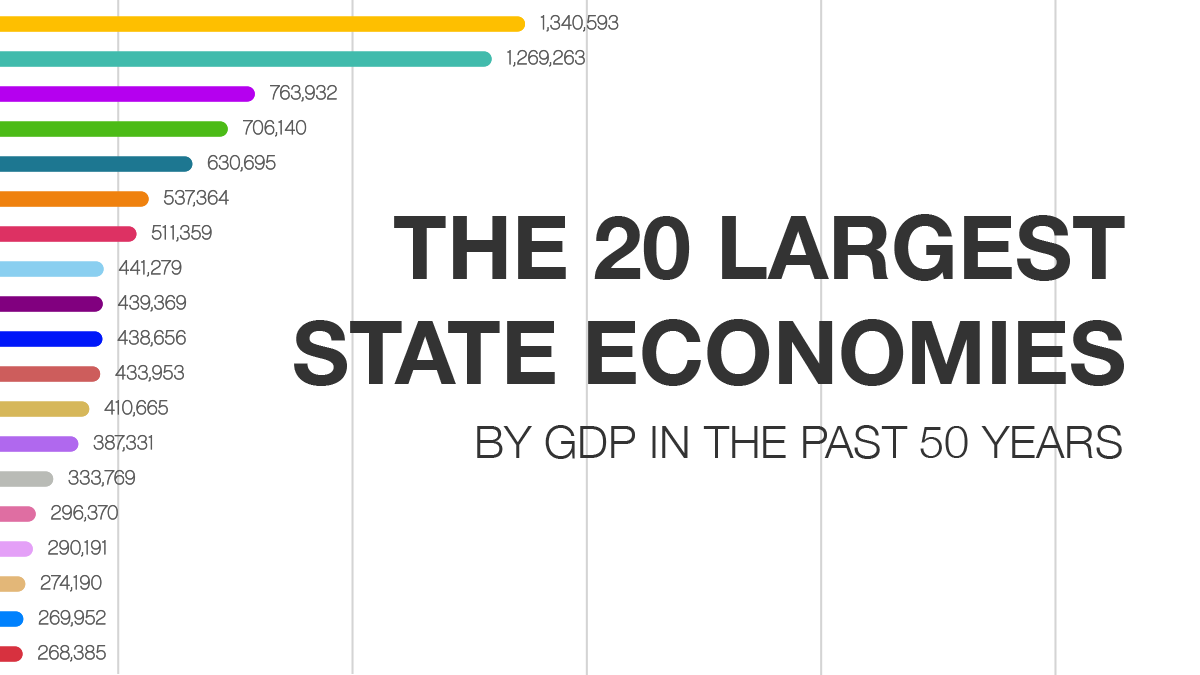
To find how the financial geography of america has modified, CashNetUSA analyzed the true GDP of the 20 largest state economies from 1967 to 2017 utilizing inflation-adjusted knowledge from the U.S. Bureau of Financial Evaluation.
Main financial developments of the previous 50 years
The foremost financial developments of the final 50 years embrace each long- and short-term modifications which have considerably altered the home financial panorama. One of many main shifts within the industrial composition of the U.S. financial system is the shift from the manufacturing to the service sector. Employment in manufacturing fell from 27.1% of the U.S. workforce in 1967 to eight.5% as of 2017, whereas the service sector rose from 66.8% to 86.3%.[2] Partially consequently, a lot of the Rust Belt — a group of manufacturing-heavy cities and states within the Midwest and Northeast — have struggled economically over the previous 5 a long time.[3] Michigan, for instance, fell from the sixth largest state financial system in 1967 to the 14th largest in 2017. Components that contributed to deindustrialization in America embrace elevated competitors from Asian steel-producing nations, the 2 oil worth shocks of the Nineteen Seventies and commerce liberalization.[4]
One of the crucial essential developments of the final 50 years was the expansion within the Solar Belt area of america, a stretch of the Southeast and Southwestern a part of the nation characterised by a heat and sunny local weather, low price of dwelling and low unemployment.[5],[6] Inhabitants progress contributed to speedy financial enlargement in quite a few states.[7] Arizona rose from the thirty third largest state financial system by GDP in 1967 to the seventeenth largest in 2007, and in 2006 Texas surpassed New York because the nation’s second largest financial system.
Sixties – Submit WW-II progress
The Sixties have been characterised by speedy financial progress and a marked enhance in actual wealth for a majority of Individuals.[8] From 1959 to 1969 U.S. GDP rose by 55.5%, the best 10-year enhance of the final six a long time..[9]
The lengthy streak of postwar financial enlargement was largely the results of elevated labor productiveness, significantly in manufacturing and agriculture, and rising federal expenditure on Nice Society packages similar to Medicaid and Medicare — in addition to the Vietnam Struggle.[10,11,12] Whereas the elevated deficit spending was capable of maintain the U.S. financial system recession-free for almost a decade, inflation started to rise in direction of the top of the Sixties, and would in the end contribute to the top of the postwar financial growth within the Nineteen Seventies.[13]
 Nineteen Seventies – Competitors from Asia
The Nineteen Seventies have been largely marked by elevated competitors from newly industrialized nations in Asia, a continued shift within the home financial system from manufacturing to the service sector and a recession that in the end signaled the top of the post-WWII period of speedy financial progress.[4],[14] The recession was induced by a 1973 oil embargo by Arab members of OPEC on exports to the U.S. and different allies of Israel that led oil costs to quadruple and lasted from November 1973 to March 1975.[15],[16] Excessive oil costs, in addition to an inflow of low-cost metal from China and different Asian nations, led to an financial slowdown in steel-producing states all through the Rust Belt.[17],[18] In the direction of the top of the last decade, manufacturing-dependent states similar to Michigan, Indiana and Ohio lagged behind the nation as a complete in GDP progress. The Nineteen Seventies ended the identical approach the last decade started – with an oil worth shock that contributed to a multi-year recession.[13]
 Eighties – From recession to progress
The Eighties started with a recession and ended with comparatively robust financial progress.[13] The recession was induced by oil shortages brought on by the 1978-79 Iranian Revolution and was exacerbated by the Federal Reserve instituting disinflationary financial coverage in response to the worth shock.[19] All through the last decade, Solar Belt states similar to Arizona, Nevada, Florida, California and Georgia skilled substantial inhabitants progress, providing new residents hotter climates, low price of dwelling and financial alternative.[5],[6],[7] Georgia started a interval of speedy financial enlargement, outpacing the U.S. as a complete in annual inhabitants progress all through the last decade and rising from the fifteenth largest state financial system by GDP to the twelfth largest.
On a Monday in October 1987, the inventory market went by means of the most important one-day share drop within the Dow Jones Industrial Common in historical past.[20] Often known as Black Monday, the occasion is taken into account the primary “trendy” inventory market crash for its velocity and attain throughout your complete market.[21]
 Nineties – The longest interval of enlargement ever
The Nineties started with a recession lasting from July 1990 to March 1991.[15] The recession was brought on by quite a few elements, together with a housing credit score crunch and diminished shopper confidence because of the Gulf Struggle.[22] Following the recession, america entered the longest interval of financial enlargement in its historical past, not experiencing one other recession till March 2001.[15] The financial progress was aided partially by the excessive availability of capital funding and extreme hypothesis across the burgeoning data know-how sector from 1995 to 2000, referred to as the dot-com bubble.[23]
 2000s – The Nice Recession, assaults and decline
The 2000s have been marked by two recessions and the 9/11 terrorist assaults. The primary recession was partially brought on by the bursting of the dot-com bubble in March 2001 and ended the longest interval of financial enlargement with out a recession in U.S. historical past.[15],[24] Financial progress was additional hindered by the 9/11 terrorist assaults.[25]
The second recession started in December 2007 and lasted to July 2009.[15] The Nice Recession was brought on by the bursting of the housing bubble in 2006 and the next failures throughout the banking sector and September 2008 inventory market crash.[26] U.S. GDP fell by 2.5% in 2009, the most important decline of the final 50 years.[1] Many states within the Solar Belt, on the heels of speedy inhabitants progress, have been much less affected by the recession than different components of the nation, and skilled comparatively robust GDP progress relative to the nation as a complete within the latter half of the last decade. In 2006, Texas surpassed New York because the second largest state financial system. In 2008, North Carolina entered the highest 10 largest states by GDP for the primary time.
 2010s – Restoration and uncertainty
The 2010s have largely been marked by the restoration from the Nice Recession and the financial results of the Trump presidency. Unemployment fell to its lowest level in almost 50 years in September 2018, and the U.S. is at the moment experiencing the second-longest interval of financial enlargement with out a recession in its historical past.[15],[27] Restoration from the Nice Recession has been largely uneven all through america, with some components of the nation returning to pre-recessionary unemployment ranges far slower than others.[6] Many states within the Northeast and Midwest, similar to New York and Illinois, have skilled comparatively lackluster GDP progress all through the last decade, whereas states within the West and South, similar to California and Texas, constantly outpace the nation as a complete.
In 2017, President Trump signed into legislation the Tax Cuts and Jobs Act, efficient for the 2018 tax season.[28] The TCJA reduces tax charges for companies and particular person earnings and, in response to most mainstream analysts, could have a modest constructive impact on U.S. financial output within the short- and long-term.[29]

A change in financial coverage
The U.S. is at the moment within the midst of its second-longest interval of post-recessionary progress, and the annual unemployment price is at a close to 50-year low.[15],[30] Whereas the most important financial developments of the final 5 a long time — the shift from manufacturing to providers within the home financial system and a rising wave of globalization within the worldwide financial system — have strongly benefited some components of the nation, different states have struggled. Within the 2016 election, Donald Trump capitalized on the financial anxiousness felt by unemployed and marginalized employees within the Rust Belt and different disenfranchised areas, profitable the presidency on an America First platform.[4] Whereas it’s too early to find out the financial results of the Trump presidency, lots of his coverage ideas — protectionist commerce coverage, decrease taxes and the undoing of Obama-era well being and environmental insurance policies — mark a pointy flip from financial coverage of the final a number of a long time.
METHODOLOGY
To establish the 20 largest state economies of the previous 50 years, CashNetUSA used inflation-adjusted GDP figures from the U.S. Bureau of Financial Evaluation (BEA). Knowledge for the years 1967-1996 are primarily based on the Commonplace Industrial Classification (SIC) system and are adjusted for inflation by the BEA utilizing chained 1997 {dollars}. Knowledge for the years 1997-2017 are primarily based on the North American Trade Classification System (NAICS) and are adjusted for inflation by the BEA utilizing chained 2012 {dollars}. The discontinuity within the time collection, beginning in 1997, was minded in our evaluation, and comparisons throughout the 2 knowledge collection have been prevented. Intercensal inhabitants estimates from the U.S. Census Bureau have been used to enrich our evaluation.
SOURCES
1. U.S. Bureau of Financial Evaluation (2019). Desk 1.1.6. Actual Gross Home Product, Chained {Dollars}. bea.gov
2. U.S. Bureau of Labor Statistics (2019). Employment, Hours, and Earnings from the Present Employment Statistics survey. bls.gov
3. Adler, S. et al. (2014). The Decline of the U.S. Rust Belt: A Macroeconomic Evaluation. Heart for Quantitative Financial Analysis Working Paper Collection
4. Valli, V. 2018. The American Economic system from Roosevelt to Trump. Switzerland: Palgrave Macmillan
5. U.S. Bureau of Financial Evaluation (2018). SARPP Regional Worth Parities by state. bea.gov
6. U.S. Bureau of Labor Statistics (2019). Native Space Unemployment Statistics. bls.gov
7. U.S. Census Bureau (2019). State Intercensal Tables: 1900-1990. census.gov
8. College of Groningen (n.d.). The Postwar Economic system: 1945-1960. let.rug.nl
9. U.S. Bureau of Financial Evaluation (2019). Desk 1.1.6. Actual Gross Home Product, Chained {Dollars}. bea.gov
10. Shackleton, R. (2013). Complete Issue Productiveness Development in Historic Perspective cbo.gov
11. College of Groningen (n.d.). The Postwar Economic system: 1945-1960. let.rug.nl
12. Bryan, M. (n.d.). The Nice Inflation. federalreservehistory.org
13. Nationwide Bureau of Financial Analysis (2012). US Enterprise Cycle Expansions and Contractions. nber.org
14. Marglin, S. and Schor, J. (1991). The Golden Age of Capitalism: Reinterpreting the Postwar Expertise. England: Oxford College Press
15. Nationwide Bureau of Financial Analysis (2012). US Enterprise Cycle Expansions and Contractions. nber.org
16. Cándida Smith, R. et al. (2011). Slaying the Dragon of Debt: Fiscal Coverage & Politics from the Nineteen Seventies to the Current; 1973-74 Oil Disaster. bancroft.berkeley.edu
17. Federal Metal Provide, Inc. (2016). How Does The Price Of Oil Have an effect on The Metal Trade? fedsteel.com
18. Stewart, T. et al. (2014). Surging Metal Imports Put Up To Half a Million U.S. Jobs at Danger. epi.org
19. Cándida Smith, R. et al. (2011). Slaying the Dragon of Debt: Fiscal Coverage & Politics from the Nineteen Seventies to the Current; 1980-82 Early Eighties Recession. bancroft.berkeley.edu
20. The Wall Road Journal. (n.d.). Dow Jones Industrial Common All-Time Largest One Day Positive aspects and Losses. wsj.com
21. Henriques, D. (2017). These Who Don’t Study From Monetary Crises Are Doomed to Repeat Them. theatlantic.com
22. Cándida Smith, R. et al. (2011). Slaying the Dragon of Debt: Fiscal Coverage & Politics from the Nineteen Seventies to the Current; 1990-92 Early Nineties Recession. bancroft.berkeley.edu
23. Investopedia (2019). Dotcom Bubble. investopedia.com
24. Roberts, E. (n.d.). What occurred through the downturn within the 2000s? cs.stanford.edu
25. Roberts, B. (2009). The Macroeconomic Impacts of the 9/11 Assault: Proof from Actual-Time Forecasting. dhs.gov
26. Cándida Smith, R. et al. (2011). Slaying the Dragon of Debt: Fiscal Coverage & Politics from the Nineteen Seventies to the Current; 2007-09 Monetary Disaster. bancroft.berkeley.edu
27. U.S. Bureau of Labor Statistics (2019). Labor Drive Statistics from the Present Inhabitants Survey. bls.gov
28. Pullen, J. (2018). President Trump Has Signed the GOP Tax Invoice. Right here’s When the Cuts Will Begin. fortune.com
29. Tax Coverage Heart. (n.d.). How would possibly the Tax Cuts and Jobs Act have an effect on financial output?. taxpolicycenter.org
30. U.S. Bureau of Labor Statistics (2019). Labor Drive Statistics from the Present Inhabitants Survey. Bls.gov
