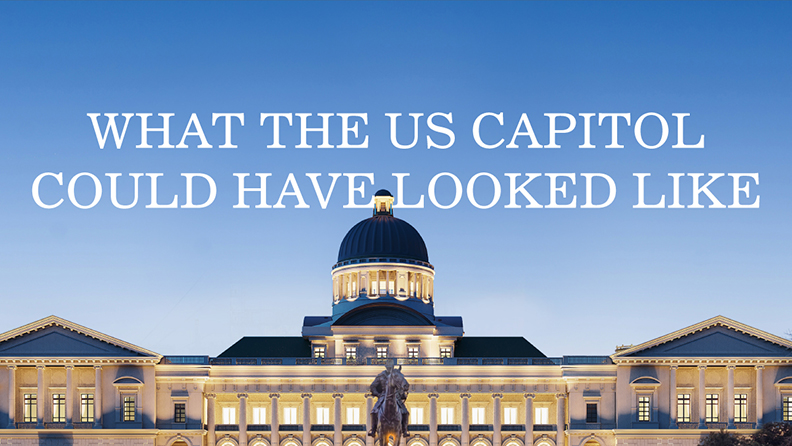
The US Capitol is the guts of American political life in Washington. This “image of the American individuals and their authorities” was initially accomplished in 1800. The constructing was chosen by means of a contest to design a gathering place for the USA Congress – and, because the shedding entries present, the Capitol might have regarded very totally different.
Actually, George Washington was dissatisfied with the primary entries the competitors obtained. “If none extra elegant than these ought to seem,” mentioned Washington, “the exhibition of structure can be a really boring one certainly.”
However then, after the deadline, a physician-turned-wannabe-architect named William Thornton was allowed to submit a late design. It wasn’t good, nevertheless it had the grandeur the commissioners have been searching for. Thornton’s design was chosen and – with some modifications – kinds the premise of the Capitol constructing you see at the moment.

We dug up one of the best of the runners-up from the competitors to design the US Capitol buildings and introduced them to life in a collection of recent photos displaying how the Capitol might have regarded.
1. William Thornton’s first US Capitol design
William Thornton was not an architect by commerce. However he was a well known polymath with a aptitude for design and a progressive imaginative and prescient for America’s future. He wrote about comets, invented a steam-powered gun, and campaigned for America’s slaves to be freed and returned to Africa. For the Capitol mission, he designed a Georgian mansion with a six-columned Portico on the entrance. This primary design additionally featured a small dome on the roof, finishing what Thornton described as “a grand define, filled with broad distinguished lights and broad deep shadows.”
Thornton delivered his design to Washington by hand. However whereas on the town, he heard of the board’s reservations about earlier designs and found that the president now needed the Capitol to incorporate a presidential residence and a dome. Thornton returned to the drafting board. He enormously elevated the size of his constructing and dome, including a taste of the Roman Pantheon so admired by Thomas Jefferson – who was Secretary of State on the time.

2. Stephen Hallet’s US Capitol design
Étienne “Stephen” Sulpice Hallet was a French-born architect. His design for the Capitol was the front-runner till Thornton confirmed up. Hallet’s Capitol grew to become referred to as the “fancy piece” in comparison with his lackluster opponents. On the request of the commissioners, he reworked his neoclassical imaginative and prescient 5 occasions till Thornton displaced him. A sympathetic George Washington wrote that Hallet’s emotions would should be “saved and soothed to organize him for the prospect that the physician’s plan can be most popular to his.”
Hallet had missed a number of the necessities of the transient, ignored the price range, and delivered a sketch that, in its fanciness, was a little bit “too French.” However reasonably than boot him out altogether, the federal government appointed him superintendent of building on the mission and requested him to repair a number of the shortcomings of Thornton’s work. At this level, Hallet apparently pushed too exhausting for his personal concepts and was finally fired. All the identical, his identify is marked on the Capitol’s cornerstone.

3. Andrew Mayfield Carshore’s US Capitol design
Carshore was a British former-soldier and trainer. Like Thornton, Carshore was an novice when he submitted his sketch. He bravely selected to attract his Capitol in perspective, which was uncommon in structure on the time, however sadly, the outcomes regarded clumsy.
Carshore’s pre-Revolutionary fashion Capitol constructing was impressed by the three-story colonial homes he had seen within the port cities of New England. It had a courtyard, quite simple home windows, and a central pedimented pavilion and portico. It appears to have fallen into President Washington’s “very boring” class because it resembled nothing fancier than a county courthouse.

4. James Diamond’s US Capitol design
James Diamond’s Capitol constructing design was pretty strong. Born in Eire, he was a working towards architect and introduced inspiration from Dublin and English stately properties to his proposal for the Capitol.
His design included a Palladian window over an arched door, rows of home windows set in arches and pediments, and an arcade alongside the bottom degree. Sadly, this design and the design he submitted for the White Home have been each rejected by judges.

5. Phillip Hart’s US Capitol design
Not a lot is understood about Phillip Hart, however he appears to have been one other enthusiastic novice. Hart’s whimsical design demonstrated a data of Renaissance structure with out an underlying understanding of the way it labored.
As our recreation demonstrates, Hart’s foreshortened prime ground seems to be a premonition of the half-sized 7½th ground within the film Being John Malkovich. The ramparts of Hart’s Capitol are lined with a dozen statues of oddly posed youngsters, who might symbolize the Twelve Labors of Hercules.

It’s exhausting to think about the US Capitol constructing every other method than it seems at the moment. However now that you simply’ve seen these different visions for the Capitol, which do you like?
Methodology
Analysis for this mission concerned numerous historic sources in regards to the design and building of Washington DC, most notably Competitors 1792: Designing A Nation’s Capitol by Jeanne Folley Butler, which contained the accessible designs and details about the architects who took half within the competitors. After sourcing all of the submitted designs, we chosen probably the most architecturally or visually attention-grabbing designs to recreate them.
SOURCES
Folley Butler, J. (1976). Competitors 1792: Designing A Nation’s Capitol. United States Capitol Historic Society
Bordewich, F. M. (2008). A Capitol Imaginative and prescient From a Self-Taught Architect. smithsonianmag.com
Architect of the Capitol. (2019). Dr William Thornton. aoc.gov
Moss, R. W., Tatman, S. L. (2019). Hallet, Stephen (a.ok.a. Etienne Sulpice) (c. 1760 – 1825). philadelphiabuildings.org
Harris, C.M. (2015). William Thornton (1759-1828). loc.gov
Go to The Capitol. (2019). 1789-1815 – The Capitol. visitthecapitol.gov
